
Arrest Records in Wayne County
Wayne County arrests can be made by the Sheriff, Detroit Police, suburban departments such as Dearborn and Livonia, Michigan State Police, transit police, campus police, or airport police. The agency that made the arrest creates its incident or arrest report. When the person enters county custody, the Wayne County Sheriff creates the booking record. The Wayne County Prosecutor or a city prosecutor then makes a separate charging decision, and the district court creates the arraignment and bond docket.
That division of work explains why there is no one Wayne County arrest-history screen. A booking record documents intake and custody. It does not prove guilt. A police report may contain alleged facts and evidence that never become a filed charge. The court file shows what the prosecutor filed and how the case ended. ICHAT adds eligible Michigan repository events after reporting, while OTIS covers MDOC custody or supervision rather than all arrests.
Wayne County Sheriff Booking Search
The Wayne County Sheriff inmate-information channel is the official starting point for current county custody. Its New World search uses name, subject number, booking number, an In Custody control, booking date range, and housing facility. Facility choices include the Adult Detention Facility, Electronic Monitoring Unit, Residential MH Treatment Programs, and Wayne County Jail. Search results identify names, subject numbers, and multiple bookings when applicable.
An opened profile can show demographic information, booking number and date, total bond, booking origin, court date, charges, docket number, disposition, sentence fields, crime class, and arresting agency. These labels describe custody data, not a verdict. No county-operated daily arrest blotter was verified. The Sheriff search is best read as a current booking and custody tool, not a complete historical Wayne County arrest database.
If the name search is unclear, a subject number or booking number provides a stronger match. The In Custody box should be used with care because clearing or selecting it changes the scope of the Wayne County results. Multiple-booking labels can represent separate intake events for the same listed subject. Read each booking date, court, and charge block on its own rather than merging them into one case.
| Sheriff Search Field | How It Narrows Wayne County Results |
|---|---|
| Name | Uses the current legal spelling to locate subject matches. |
| Subject Number | Distinguishes the listed subject from a similar name. |
| Booking Number | Targets one intake event when the number is known. |
| In Custody | Limits results to people currently jailed when selected. |
| Booking From and To | Narrows the search to a known booking-date range. |
| Housing Facility | Filters by the listed detention, monitoring, or treatment location. |
Search and Clear controls run or reset the Wayne County form, and a result can identify multiple bookings for one subject.
Wayne County Arrest Lookups
Use more than one channel when the result matters. A recent booking may appear before a court case, while an older arrest may no longer be visible in current custody. The arresting agency, Sheriff, court, and Michigan State Police answer different questions. Phone and counter contact remain useful when an online screen has no match.
- Search the Wayne County Sheriff inmate channel for current custody, using the booking number or exact name when known. Use MI-VINE or its automated line at 1-800-770-7657 for custody status and notification.
- Ask the arresting police agency for its incident or arrest report. Give the incident number, date, place, agency, and requested record type.
- Search the correct district court for arraignment and bond. Follow a felony into Third Circuit after bindover to see the filed charges and outcome.
- Use MSP ICHAT for eligible public Michigan repository information. For review of your own identity-based Michigan record, follow the official fingerprint procedure.
- For older Sheriff booking material, submit a precise WCSO FOIA request, call 313-833-0562, or contact the published coordinator at the Russell Street office.
ICHAT excludes warrants, suppressed records, juvenile matters, traffic cases, federal and tribal matters, other states, and some local misdemeanors. A no-record response proves only that the public search found no included match.
Four Wayne County Arrest Custodians
One Wayne County arrest can create four core records. First, the police agency writes an incident or arrest report. Second, the Sheriff creates booking, bond, housing, and release entries when county intake occurs. Third, the prosecutor authorizes, changes, or rejects charges. Fourth, the district court records arraignment and bond, with Third Circuit taking a felony after bindover. A statewide repository entry may follow after fingerprints and dispositions reach MSP CJIC.
- Incident or arrest report
- The arresting agency supplies the routine records route or FOIA channel.
- Booking and intake
- The Wayne County Sheriff supplies the inmate search and Sheriff FOIA route.
- Arraignment and bond
- The district court supplies its docket and clerk record.
- Felony adjudication
- Third Circuit supplies Odyssey Public Access and Circuit Clerk copies.
- Repository history
- MSP CJIC supplies ICHAT or the official own-record review procedure.
This route is especially important in Detroit, where a DPD report belongs to the city but the booking may belong to the Wayne County Sheriff.
Arrest Records: What They Contain
A Wayne County arrest record can identify the agency incident, legal basis, arrest time and place, subject descriptors, alleged offenses, property or evidence references, and the officer or agency involved. Jail intake adds a booking number, fingerprints, a control number, booking photograph, charge list, holds, court, bond, and custody status. Public release varies by field and can change as the prosecutor and court act.
| Booking Number | Identifies a specific Wayne County jail intake and helps separate repeat bookings. |
|---|---|
| Booking Date & Time | Shows when intake occurred, which may differ from the incident time. |
| Arresting Agency | Names the police or sheriff unit that holds the arrest report. |
| Charges | Lists intake allegations that may change after prosecutor review or arraignment. |
| Bond | Shows public bond numbers or amounts and the issuing court when available. |
| Booking Photograph | May exist in the jail file, but public availability must be confirmed with the Sheriff. |
| Release Status | Reflects custody, release, transfer, or another current status rather than guilt. |
Juvenile information, victim data, medical or classification details, and LEIN material can be withheld. Public fields are not the full law-enforcement file.
Wayne County Bookings Reach MSP
At Wayne County booking, fingerprints and a tracking or control number link the person to the arrest event. Reportable fingerprint-supported arrests move to the Michigan State Police Criminal Justice Information Center. Prosecutors and courts later report their decisions and dispositions. A lag, data mismatch, or failed link can leave an arrest without its final outcome in a public repository result.
That is why a Wayne County court judgment should be checked when an ICHAT entry appears incomplete. Preserve the search transaction and obtain the court disposition. MSP provides the RI-026 challenge process for a public criminal-history result, while a court may use the RI-027 Judicial Correction Worksheet when it cannot send the update electronically. The local court record is the best source for what happened to the filed charge.
Note: A missing disposition may reflect reporting or matching trouble, not an unresolved case or a finding of guilt.
Recent Wayne County Bookings
No verified countywide daily arrest blotter publishes a full Wayne County arrest history. Use the Sheriff inmate search for current bookings and custody. Entries can include more than one booking and may display charge, bond, court, and disposition fields. New arrivals can wait for Jail Registry processing, so an immediate search can lag behind the actual intake.
MI-VINE adds custody notification but is not a historical arrest index. It can help track status changes after a current match. When a person leaves Wayne County custody for a state sentence, use MDOC OTIS. The official Offender Tracking Information System shows its own search and supervision layer.
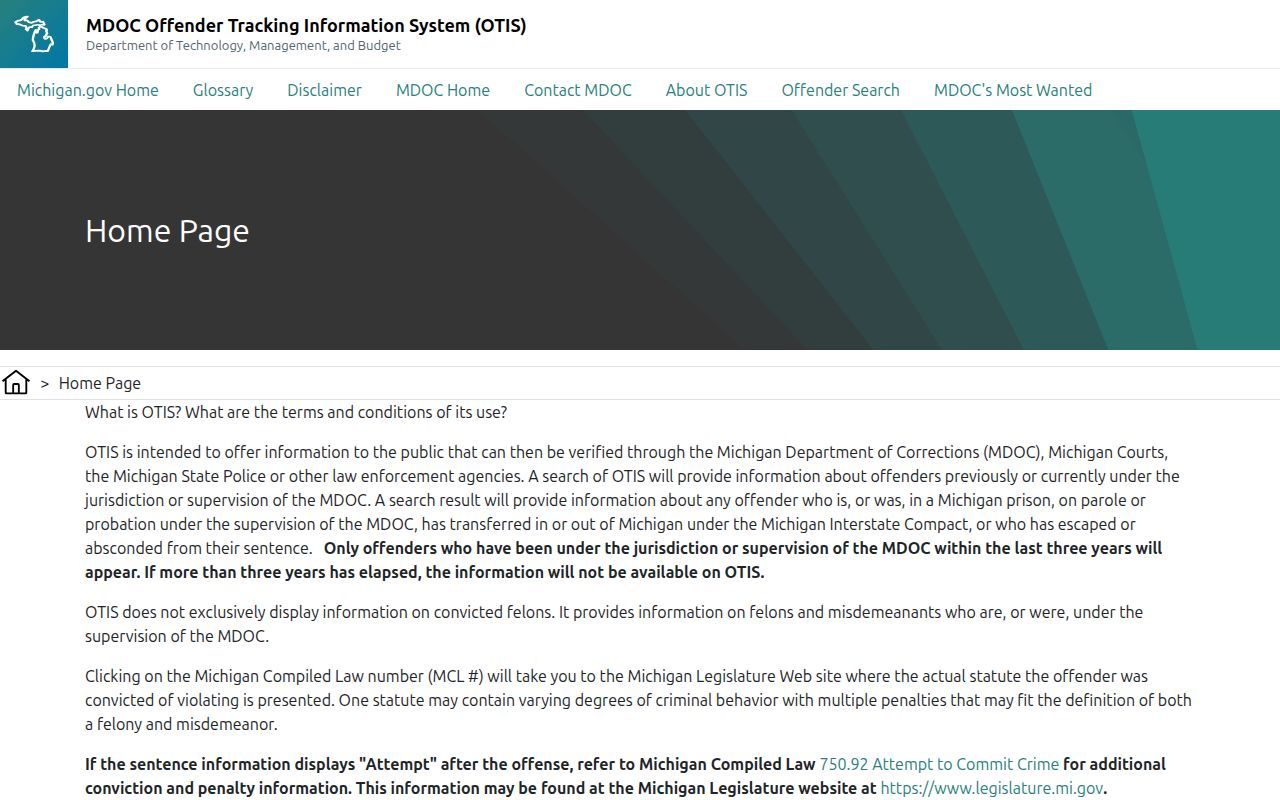
OTIS covers people under MDOC jurisdiction and certain recent discharges. It is not a Wayne County booking log, and a negative result says little about an old local arrest.
A transfer also changes which office can answer a custody question. The Wayne County Sheriff remains the source for the county booking, while MDOC becomes the source for current state custody or supervision. Court dockets still show the sentence that led to the transfer. These systems may update on different schedules, so compare the identifiers and event dates before concluding that two screens conflict.
Older Wayne County Booking Requests
When a Wayne County booking has rolled off the live custody screen, ask for an existing Sheriff record through FOIA. A useful request names the Sheriff division, incident or booking number, date range, location, subject as needed, and desired format. Request records, not answers to questions. The NextRequest portal supports submission and later request tracking.
Wayne County Sheriff FOIA
Cynthia Golson, FOIA Coordinator
5301 Russell Street
Detroit, MI 48211
313-833-0562
cgolson@waynecountymi.gov
Michigan FOIA generally calls for a response within five business days by grant, denial, partial grant, a permitted extension notice, or notice that the record does not exist. That is not a guaranteed production date. Active investigations, juvenile information, LEIN data, victim identity, medical records, and private information may be withheld or redacted. Court case records go to the clerk, not through Sheriff FOIA.
The general Sheriff information address is not a channel for legal pleadings. Use the request portal or the named FOIA coordinator for Wayne County booking records. If the record began with a city police department, request that city's incident report separately because the Sheriff cannot produce a file it does not hold.
Which Wayne County Police Agency?
The location of the encounter determines who holds the police report. Detroit Police reports go through Detroit's Law Department FOIA route. Dearborn and Livonia each operate city records channels. Michigan State Police uses its own public-records process. Detroit Transit Police, Wayne State University Police, and Airport Authority Police also keep agency records rather than sending every report into one Wayne County archive.
For any agency, provide the incident number if available, date and time, exact location, report type, and a narrow range for body-camera, dispatch, 911, photo, or video material. The agency may ask about the requester's relationship to the event when release rules differ. Police files can be redacted while a public court complaint remains available. To follow filed charges and the judgment, use the Wayne County court case lookup.
Arrest Records vs Conviction Records
Wayne County arrest and conviction records answer different questions. The police and jail document an encounter, legal authority, and intake. The prosecutor may reject or revise the alleged charge. A court conviction exists only after a plea or finding of guilt and a judgment. Release from custody, bond, or a booking photo does not show how the case ended.
| Arrest Record | Conviction Record |
|---|---|
| Created by the arresting agency and jail | Created by the court after a guilty outcome |
| Shows that an arrest or booking occurred | Shows the charge adjudicated and judgment entered |
| Lives with police, Sheriff, or booking systems | Lives with the court clerk and eligible state repository records |
| May end with release, no charge, or dismissal | May lead to sentence, appeal, or a lawful set-aside |
Note: A Wayne County arrest is not proof of guilt, and an initial Wayne County booking charge may be rejected, dismissed, changed, or end in acquittal.