
Wayne County Criminal History Checks
Begin with the kind of event, not with a broad name search. A Wayne County police report, sheriff booking, district court case, Third Circuit felony file, and Michigan State Police repository result are separate records. A name may appear in one and not another for sound legal or timing reasons. The correct Wayne County court also depends on where the case began. Detroit matters start in the 36th District Court, Dearborn matters in the 19th, and Livonia matters in the 16th. Wayne County felonies move to the Third Judicial Circuit only after bindover.
Use a case or booking number when one is known. For a name search, keep spelling variants and a middle name ready, then compare the Wayne County court, filing date, event history, and public year-of-birth data when available. Michigan court sites omit protected identifiers, so a name match alone does not establish identity. A certified Wayne County judgment from the clerk is the sound choice when the exact outcome must be confirmed.
- Search the district court that handled the first hearing, or Third Circuit for a felony after bindover.
- Check Wayne County Sheriff inmate information for a recent booking or current county custody.
- Use ICHAT for the public Michigan repository slice, with its stated exclusions in mind.
- Read the docket disposition and sentence rather than relying on the original arrest charge.
- Ask the proper clerk or records unit for a certified or older record that is not online.
Wayne County Search Channels
No single database supplies a complete Wayne County criminal record. The Wayne County court is best for what was filed and what a judge ordered. Wayne County Sheriff data answers current booking and custody questions. A city police department keeps its own incident and arrest reports, even when the person later enters county custody. MSP compiles eligible Michigan events through ICHAT, while the Michigan Department of Corrections uses OTIS for people under state custody or supervision and certain recent discharges.
| Channel | Best Use | Main Limit |
|---|---|---|
| District court or MiCOURT | Misdemeanors and early felony events | Participating courts and public fields only |
| Third Circuit OPA | Wayne felony files after bindover | Not every document image is online |
| Wayne Sheriff | Booking and current county custody | Not a full historical rap sheet |
| ICHAT | Eligible public Michigan history | Named exclusions and name-match risk |
| OTIS | MDOC custody and supervision | Not a complete criminal history |
This Wayne County channel map also explains why two official results can differ without either being false. Each office records a different stage and applies a different access rule.
Official Background Checks in Michigan
The Michigan State Police Criminal History Records hub routes the public to ICHAT, fingerprint record review, correction forms, and set-aside information. ICHAT is a name-based product. Its required subject fields include first name, last name, sex, race, and date of birth. The published charge is $10 for each search. A no-record response does not prove that the subject has never been arrested because the system omits warrants, suppressed records, juvenile matters, federal and tribal cases, traffic records, other-state history, and some local misdemeanors.
Fingerprint comparison is the stronger identity method. Michigan uses authorized Live Scan vendors and Wayne County law-enforcement agencies, but appointments, service codes, hours, and vendor charges vary. MSP also has a fingerprint-based procedure for a person reviewing their own Michigan record. Federal history requires a separate subject-only FBI Identity History Summary. Neither a fingerprint summary nor ICHAT replaces the pleadings and judgment in a Wayne County court file.
The official MSP page shown below is the source for these record-review paths.
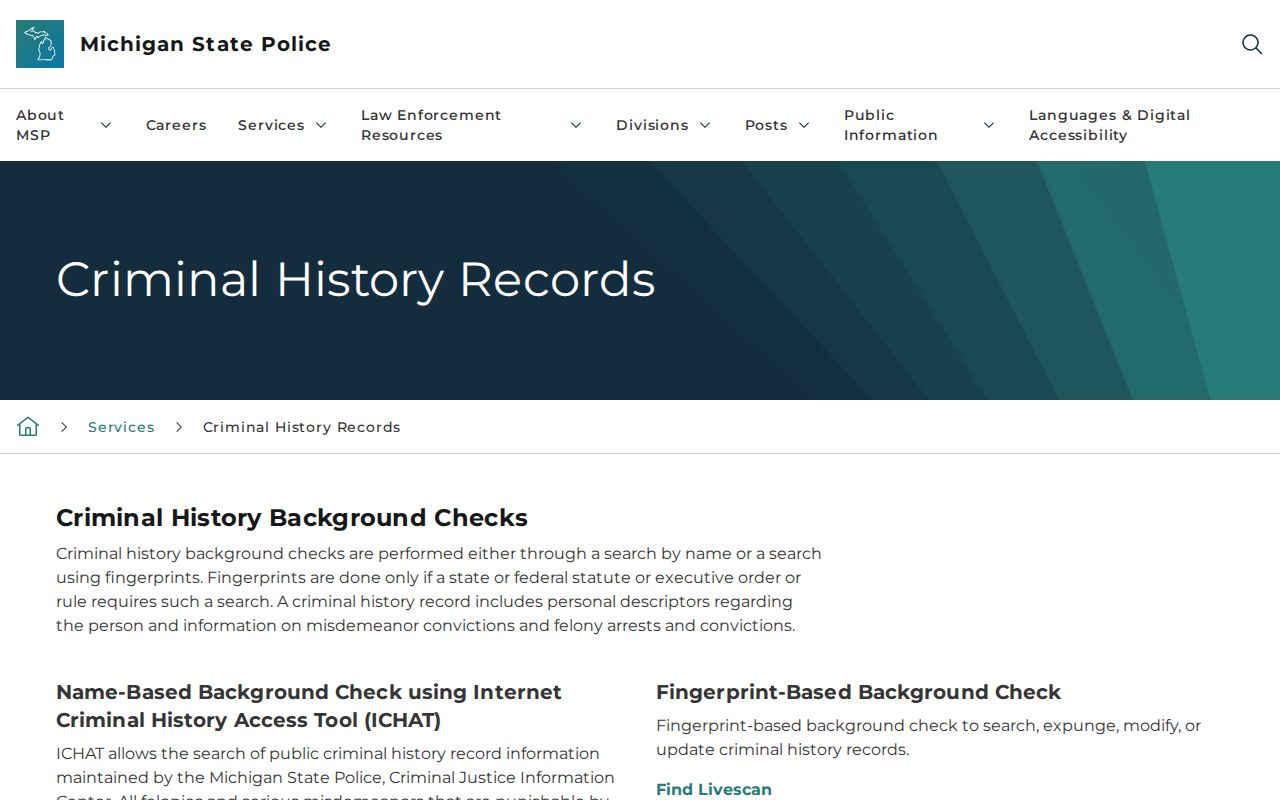
Its distinct links are a useful reminder to choose between a public name search, personal fingerprint review, and record correction.
Wayne County Justice Center Records
The Wayne County Criminal Justice Center at 5301 Russell Street in Detroit now places several major custodians on one campus. Operations moved there on September 3, 2024. The complex includes the Third Circuit Criminal Division, Clerk Criminal Records, sheriff detention functions, the prosecutor, and MDOC services. Old forms and search results may still point to the former Frank Murphy Hall of Justice or former jail buildings. Verify the current suite before a counter visit.
The move joined buildings, not Wayne County records. Sheriff staff control booking and custody files. Clerk staff maintain the Wayne County court case. Prosecutor material is governed by different limits and may include work product or investigative content that is not open like a docket. The published campus routing lists Clerk Criminal Records at Suite 100 and 313-224-2502, Third Circuit at Suite 700 and 313-224-5261, and the Sheriff at Suite 400 and 313-833-0864.
Clerk Criminal Records
5301 Russell Street, Suite 100
Detroit, MI 48211
313-224-2502
Wayne County Sheriff
5301 Russell Street, Suite 400
Detroit, MI 48211
313-833-0864
Free public parking is listed for Lot B at 5560 Rivard Street and Lot C at 5300 Russell Street. Follow current secure-campus signs because access points and unit locations can change.
Kinds of Criminal Records
A Wayne County police incident report describes the reported event and investigation, which may end without an arrest. An arrest report states the agency's arrest basis. Wayne County booking data records jail intake, holding charges, bond, and custody. Once a prosecutor files a charge, the district or circuit clerk creates the public Wayne County case chronology. MSP later compiles eligible fingerprint-supported events in the state repository. OTIS and the Michigan Public Sex Offender Registry each serve narrower correctional or registration roles.
- Police records: incident narratives, arrest facts, dispatch data, and releasable evidence held by the creating agency.
- Court records: complaints, hearings, motions, pleas, judgments, sentences, and public register-of-actions entries.
- Booking records: jail intake identifiers, charges, bond, court dates, and present custody details.
- Repository records: the eligible Michigan arrest and conviction data that MSP makes public through ICHAT.
- Supervision records: court probation entries or limited MDOC custody, parole, and probation information in OTIS.
For a case's filed charge and result, use the Wayne County court case lookup. That file is more authoritative than a booking label that can change at arraignment.
Wayne County ICHAT Record Gaps
ICHAT reports Michigan felony arrests and convictions and serious-misdemeanor convictions punishable by more than 93 days within the public product's rules. It does not display every Wayne County police contact. Warrants are excluded on purpose. So are federal, tribal, other-state, juvenile, traffic, and many local-misdemeanor matters. A recent Wayne County arrest can also appear before its prosecutor or court disposition has been properly matched.
If an ICHAT entry lacks a result, first obtain the judgment or register of actions from the Wayne County court. Preserve the ICHAT transaction and result, then use MSP's RI-026 public criminal-history challenge process. A Wayne County court may use the RI-027 Judicial Correction Worksheet when it cannot send the fix electronically. Do not assume that a dismissed case is the same as a set-aside case. Dismissal is a case outcome; a set-aside changes public access under a separate statute and process.
Record mismatch: Compare the court number, charge, disposition, and sentence before asking MSP to correct an eligible repository entry.
Wayne County Criminal Records: What They Contain
A Wayne County record may begin with personal descriptors and an agency incident or booking number. The court record then adds the case number, prosecutor charge, judge, events, disposition, and sentence. A fingerprint-supported MSP cycle can tie the arresting agency to later prosecutorial and judicial reports. Public versions omit data that law or court rules protect, including Social Security numbers, full financial account data, driver's-license numbers, victim details, and nonpublic juvenile material.
| Name and Identifiers | Public name, aliases, case or booking number, and limited descriptors where law permits. |
|---|---|
| Arrest and Booking | Arrest date, agency, holding charge, booking date, facility, bond, and court routing. |
| Charges and Statutes | Police allegation, prosecutor-authorized count, statute citation, and offense level. |
| Disposition | Dismissal, plea, verdict, or other public outcome for each filed count. |
| Sentence | Jail, prison, probation, fines, costs, or other terms entered by the judge. |
| Custody or Supervision | Separate sheriff, court, or MDOC status within that system's coverage. |
Read each Wayne County field in sequence. An arrest charge can differ from the prosecutor's charge, and both can differ from the count of conviction.
Wayne County Custody Record Layers
A recent booking belongs first in the Wayne County Sheriff search. Its current system can be searched by name, subject number, booking number, custody status, booking-date range, and housing facility. Results may include multiple booking blocks, demographic labels, bond information, charges, court dates, disposition, and arresting agency. It is not a countywide daily arrest blotter, and it should not be read as proof of guilt.
MI-VINE adds custody notifications, while OTIS covers MDOC prisoners, parolees, probationers, and people discharged within the preceding three years. A person can leave Wayne County jail for MDOC custody, which moves the useful Wayne County status search from the sheriff to OTIS. Older county booking material may require a focused Wayne County Sheriff FOIA request instead of either live database.
The MDOC OTIS service is distinct from a Wayne jail search and from ICHAT. A negative OTIS result does not clear a criminal history.
Federal custody is another layer. The Federal Bureau of Prisons inmate locator searches by name or federal identifier.
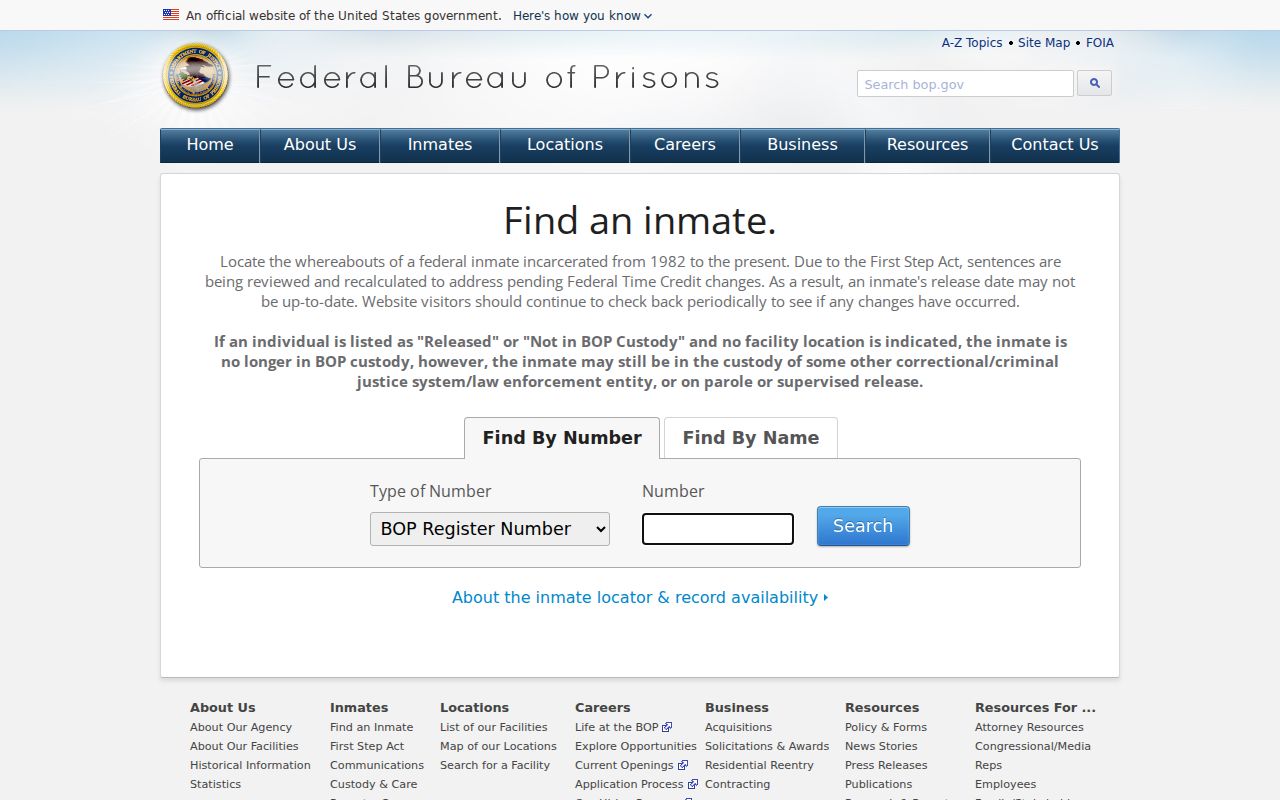
The federal locator does not cover the Wayne County jail or MDOC facilities.
Michigan Public Access Laws
Michigan FOIA governs records held by executive public bodies, including releasable county and city police material. It does not turn a judicial file into a sheriff FOIA record. Court files instead follow Michigan court access rules. A focused FOIA request should name the agency, incident or booking number, date range, location, and desired format. Under MCL 15.235, a public body generally responds within five business days by granting, denying, granting in part, issuing a permitted extension, or saying the record does not exist. Production can take longer.
Key Michigan access rules:
MCL 15.231 et seq. sets Michigan FOIA policy, access, fee, response, and exemption rules.
MCR 1.109 protects specified personal identifying information in court filings.
MCL 28.241a et seq. governs Michigan criminal-history information and dissemination.
MCL 780.621 et seq. controls application-based conviction set-asides.
Active Wayne County investigation data, LEIN material, juvenile records, victim information, medical facts, and private details can be withheld or redacted. When exempt and public material can be separated, the office should provide the releasable part.
Wayne County Warrant Record Limits
No reliable public countywide warrant database was found for Wayne County. ICHAT expressly excludes warrants, and an online court search may not show current warrant status. Start with the issuing court. Detroit misdemeanor or traffic matters often belong to the 36th District Court; suburban cases remain with their local district court; circuit warrants belong with Third Circuit. Public docket entries such as capias, failure to appear, or bond forfeiture can provide clues, but only the court or official law-enforcement channel can confirm live status.
A person resolving their own possible Wayne County warrant should contact the court or counsel before appearing and ask about bond instructions. Livonia's 16th District Court is unusually direct: its case search does not display warrant status, and the clerk routes questions at 734-466-2500 on weekdays from 8:30 a.m. to 4:30 p.m. It also describes 9 a.m. walk-ins where the warrant may be recalled before a judicial officer, with cash bond possibly required. Never replace these official Wayne County routes with a people-search or warrant aggregator.
Restricted, Sealed & Expunged Records
Michigan uses both set-aside and expungement language. The Clean Slate laws allow application-based and automatic set-asides for qualifying convictions. Eligibility turns on the number and type of convictions, waiting periods, excluded offenses, and rules that may treat several offenses as one conviction. Serious assaultive crimes, life-maximum crimes, specified child-abuse and sex offenses, and some traffic matters can be excluded or limited.
A Wayne County application commonly requires the current court form, a certified judgment or register of actions, fingerprints, MSP processing, service on required agencies, filing in the court of conviction, and a hearing when set. Wayne County Clerk links forms MC 227, MC 227a, and MC 227b for different paths. Wayne County public searches should be checked again after relief because automatic matching or reporting errors can delay removal. A set-aside narrows public access but does not erase every statutorily authorized law-enforcement use.
Wayne County Record Set-Asides
Wayne County applicants should verify the active filing counter because older forms may retain legacy downtown addresses. Third Circuit Docket Directive 2025-02 governs local filing details. For the MSP part of the process, a Michigan resident obtains an RI-008 fingerprint card. A Live Scan agency may capture the prints but provides the printed card for this application route.
The MSP packet includes fingerprints, the Wayne County application, the required certified court record, and a $50 check or money order payable to the State of Michigan. It goes to MSP CJIC at P.O. Box 30266, Lansing, MI 48909-7766. MSP advises allowing about eight weeks. The form's listed waiting periods include seven years for more than one felony, five years for one felony or specified matters, and three years for eligible misdemeanors, measured from the latest controlling completion event. The exact statute and current form control each case.
Federal Criminal Records in Wayne County
Federal cases from Wayne County belong to the U.S. District Court for the Eastern District of Michigan, Southern Division, not to Third Circuit. The Theodore Levin U.S. Courthouse is at 231 West Lafayette Boulevard in Detroit. PACER supplies the official federal docket after registration and applies its current fee schedule. The federal docket can contain complaints, indictments, motions, judgments, and case events. Sealed matters and active federal warrants are not a public lookup product.
The distinction matters in central Detroit, where local, state, and federal record custodians sit close together. A BOP custody result does not supply the federal court judgment, just as a Wayne sheriff result does not supply the Third Circuit judgment. Use the court number and agency named on the document to choose the next source.
City-by-City Criminal Records in Wayne County
Wayne County's three largest incorporated cities use different police and district-court systems. Detroit Police reports go through Detroit, and the 36th District Court keeps its local docket. Dearborn routes police copies through city FOIA and court files through the 19th District. Livonia uses its Central Records unit and 16th District Court. Felonies from all three can reach Third Circuit after bindover, while county custody remains with the Wayne Sheriff.
Detroit Record Check
645,705 residents. Use DPD records and the 36th District Court before tracing a felony to Third Circuit.
Dearborn Record Check
106,377 residents. Police FOIA and 19th District records use separate city channels.
Livonia Record Check
93,113 residents. The 16th District publishes clear search, warrant, and certified-copy limits.
These 2024 Census estimates establish the city-page order. A city record may later flow to county or state systems, but the local custodian remains the best first source for its own report.
The MiCOURT Case Search shown here covers participating trial courts and requires the correct court selection.
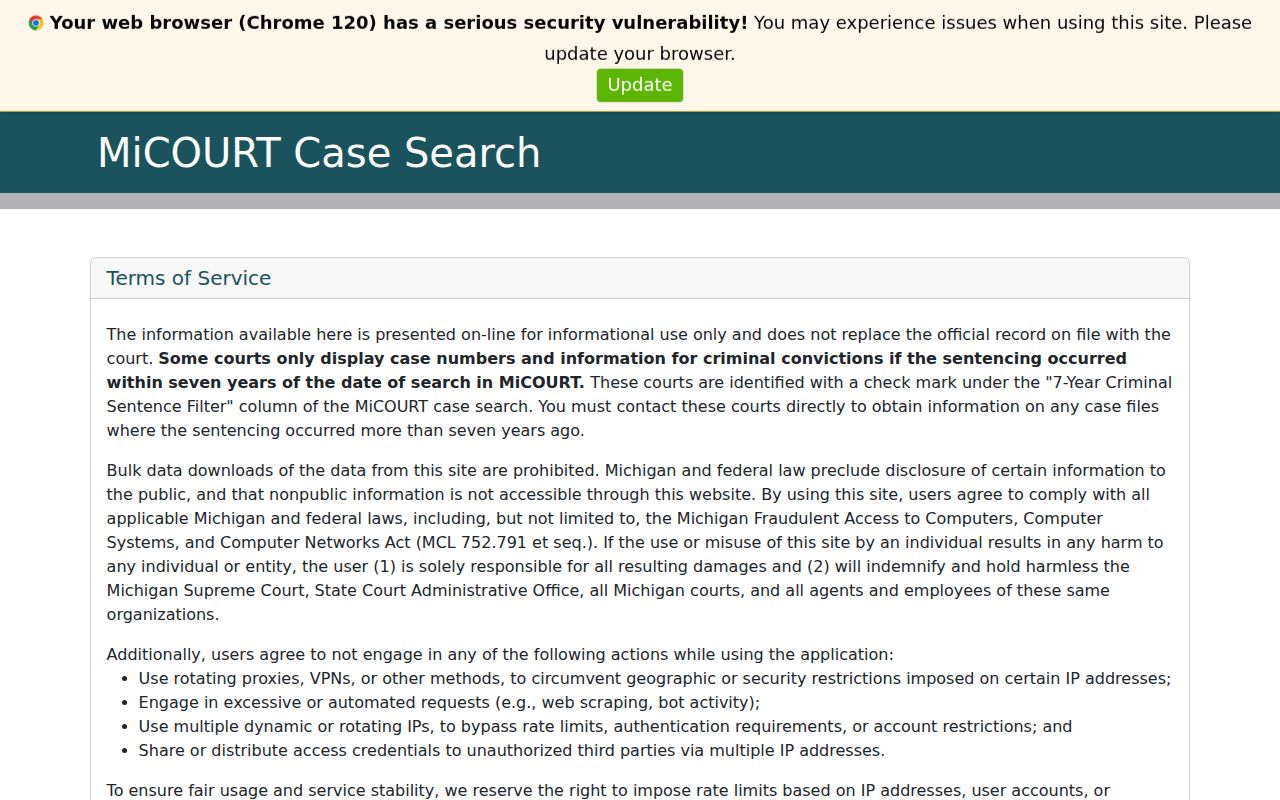
Its party and case searches do not replace certified records from Detroit, Dearborn, Livonia, or Third Circuit clerks.
| MiCOURT Field | Use in a Wayne County Search |
|---|---|
| Court | Select the exact participating district or circuit court. |
| Search Type | Choose a case-number or party-name search when offered. |
| Case Number | Keep the court prefix and year for the strongest match. |
| Party Name | Use first, last, and optional middle name to narrow results. |
| Category and Date | Apply criminal case and filing-date filters when available. |
Protected birth dates and driver-license numbers are not expected public matching fields under Michigan court rules.
The Third Circuit Criminal Division is the official county source for felony cases after bindover.
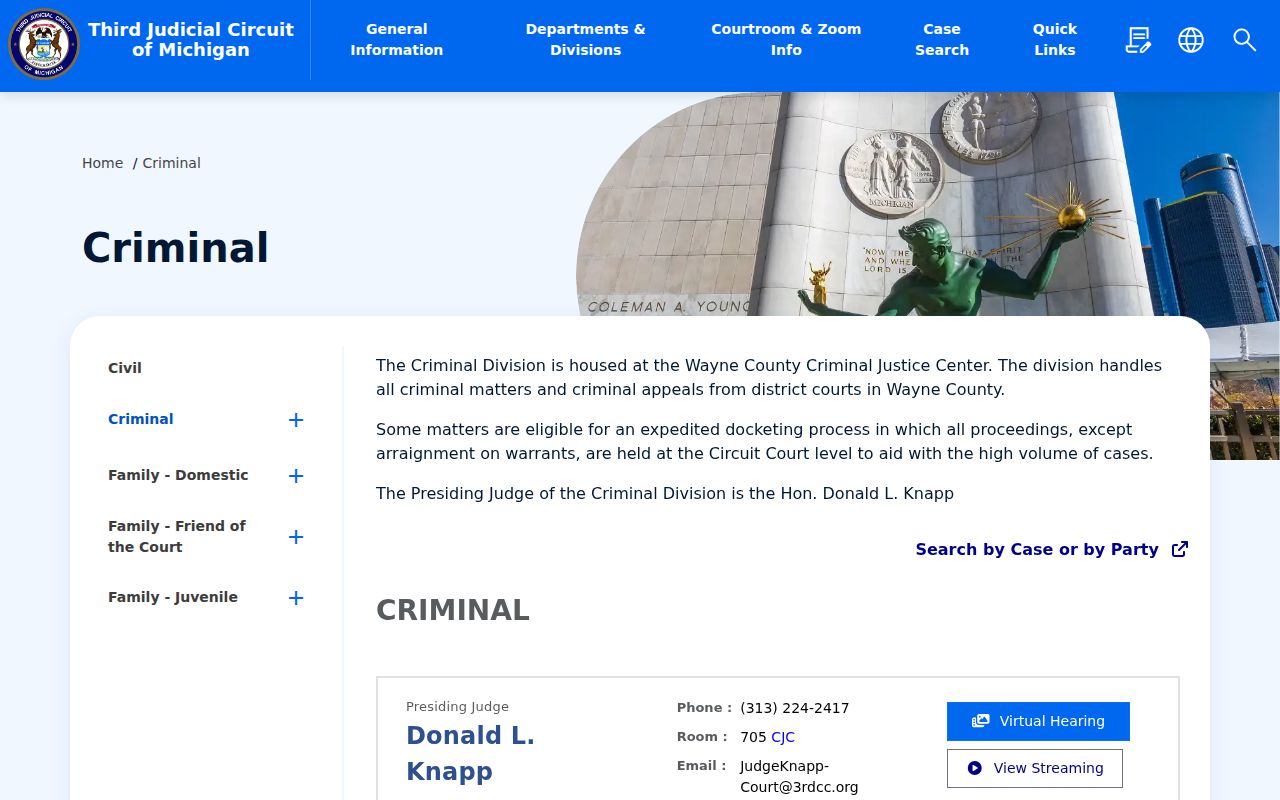
The division's role begins after district-court felony screening, which is why both court levels may have a file for one prosecution.